
Why the UK AI Adoption Gap Is a Franchise Opportunity
NatWest warns smaller UK firms are falling behind on AI. Here is what the AI adoption gap means for small businesses, and where an AI digital agency franchise fits.
 By Anthony PhillipsPublished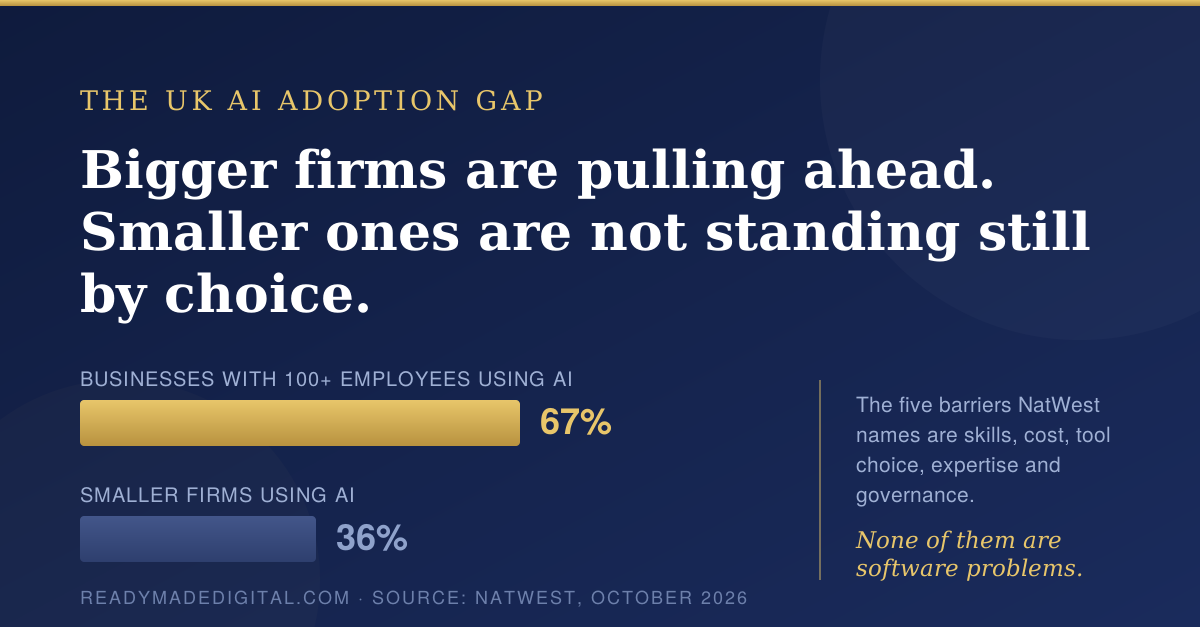
At the start of October, NatWest published research that put a number on something anybody working with small businesses already suspected. AI use is spreading quickly through larger organisations and far more slowly through smaller ones.
The bank found AI in use at 67% of businesses with more than 100 employees, against 36% of smaller firms. Only 6% of current users have reached the stage where AI is genuinely transforming operations, decision making and customer experience. Robert Begbie, CEO of Commercial and Institutional Banking at NatWest, described the risk plainly, saying there is a real risk of an AI adoption divide with smaller businesses facing greater barriers.
What makes the research useful is not the headline. It is the list of reasons underneath it.
The five barriers, and why none of them are software problems
NatWest identified five barriers holding smaller firms back: skills gaps, cost pressures, uncertainty over which tools to use, limited in-house expertise and readiness, and concerns around security and governance.
Read that list again and notice what is missing. Nobody is saying the technology does not work. Nobody is saying it is unavailable. The tools are cheap, abundant and a browser tab away.
The barriers are all human and organisational. A business owner who does not know which of forty products to pick, has nobody internally who could implement it, is nervous about data handling, and is already working a sixty hour week, does not have a software problem. They have an implementation problem.
That distinction matters, because software companies cannot solve it. You cannot sell your way past a skills gap. Somebody has to turn up, understand the business, choose the tools, configure them, connect them to what the business already runs on, and stay involved when something breaks.
Where this becomes an AI franchise opportunity
This is the gap that an AI digital agency franchise exists to fill, and it is the reason the model is viable now in a way it would not have been five years ago.
A small business does not want a platform licence. It wants a named person who understands what it does, who can explain in plain language what AI will and will not fix, and who takes responsibility for the outcome. That requirement is local, personal and relationship led, which is precisely why it suits a franchise network rather than a centralised software company.
At Ready Made Digital, the split is deliberate. Our partners bring the relationships, the local credibility and the commercial conversations. Behind them sits a team with more than twenty years of experience in the digital space, covering website build, SEO, paid media, automation and AI led lead handling, which scopes, quotes, builds, delivers and supports every piece of client work under the partner's own brand.
That structure directly answers three of NatWest's five barriers at once. The skills gap is covered, because the delivery team holds the skills. The uncertainty over which tools to use is covered, because the stack is already chosen, tested and in production across a client base. The readiness and expertise issue is covered, because the client is not being asked to build anything internally.
The cost barrier is a packaging problem
Cost pressure is the fourth barrier and it deserves a straight answer rather than a dismissal.
Small businesses are not wrong to be cautious about spend. What they object to is open-ended cost with vague benefit, which is what most AI conversations sound like to an owner with a full diary. The firms that are buying are buying specifics: an enquiry that gets answered at eleven at night instead of Monday morning, a quote that goes out the same day, a receptionist who is no longer trapped on the phone.
Those are measurable, bounded pieces of work. Sold that way, the cost conversation becomes a return conversation, which is a far easier one to have.
Governance is the fifth barrier, and it is getting louder
The final barrier NatWest names is security and governance, and the news cycle is not making that easier. In the same week, representatives from the major AI labs told New York City lawmakers they could not guarantee their AI agents would always follow safety guardrails, and the FCA set out its expectations on frontier AI and cyber resilience for regulated firms.
For a small business owner, the practical conclusion is not that AI is unusable. It is that unsupervised, unconfigured AI is a poor idea, and that the sensible route is a bounded system with clear rules, human oversight and somebody accountable for it.
That is how we deploy. Our AI conversation platform, Risponda, runs with defined reply modes, escalation rules and transfer conditions, so a business decides exactly how much the AI handles and at what point a human takes over. Pricing conversations, for example, go to a person. That is a configuration choice, and configuration choices are what separate a managed deployment from an experiment.
What the research actually tells a prospective partner
If you are weighing up a move into this market, the NatWest findings are worth reading as a demand signal rather than a warning.
A large and clearly defined population of UK businesses knows it is behind, has named the reasons, and cannot resolve them internally. That is an unusually clean market position. The constraint on the sector is not demand, it is the number of capable people available to meet it.
The AI adoption gap will close eventually. The question is who is standing in front of those businesses while it does.
If you would rather see how the model works than read about it, that is what the demo call is for.
Ready to Take the Next Step?
Book a free consultation with the Ready Made Digital team and explore how we can help grow your business.
Get in Touch